It has the same form as the present participle:
running, working, speaking, etc.
It can be used:
1. as subject of a sentence >Talking about
work is work
2. after prepositions > By thinking, … against staying
in bed
3. after certain verbs
4. in noun compounds: > a waiting room
1. Subject
Either infinitive or gerund can be the subject of a sentence when an action is being considered in a general sense
After the verb to find we can omit the verb to be:
****
2. Verbs followed by the gerund as the object of the sentence:
| Admit Anticipate Appreciate Avoid Consider Defer Delay Deny Detest Dislike Dread Enjoy Escape Excuse Fancy (imagine) Finish Forgive Imagine |
Involve Keep (continue Loathe Mind Miss Pardon Postpone Prevent Propose (suggest) Recollect Remember (recollect) Resent Resist Risk Save Stop Suggest understand |
ex. I usually avoid talking to him
I detest going to the cinema
****
It is used in short prohibition:
When followed by an object:
****
3. Gerund after prepositions
ATTENTION!!
To after the auxiliary verbs be, have,
ought, used and after going is part of the infinitive
of the following verb (I have to go to school tomorrow).
To is also placed after love, like, hate, want, try,
hope, mean to avoid repetition of an infinitive already mentioned:
Otherwise ‘to’ after a verb will probably be a preposition and will be followed by a noun, or a gerund.
A good way of finding out whether a ‘to’ is a preposition or a part of an infinitive is to see if it is possible to put a noun/pronoun after it. This ‘to’ therefore is a preposition, and verbs used after ‘to’ must be gerunds.
But
****
4. Verbs + possessive adjective/pronoun object + gerund
A number of verbs and prepositions can be followed directly by the gerund or by possessive adjective/pronoun object + gerund.
a. If the verb or verb+preposition is followed by the gerund, the gerund refers to the subject of the verb:
If we put a possessive adjective or pronoun before the gerund it refers to the person denoted by the possessive:
b. Useful verbs and expressions which can take either constructions
are:
dislike, like (negative), dread, fancy, mean, mind, involve, propose, recollect,
remember, resent, save, stop, suggest, understand, approve/disapprove of, insist
on, object to, it’s non good/use, there’s no point in, what’s
the point of.
c. In formal English the possessive adjective is used with the gerund. But in spoken and less formal English we very often use the pronoun. It is recommended to use the pronoun.
5. Nouns with gerunds.
In very formal English the possessive case is used:
But it is much more usual to omit the ‘s:
6. Perfect gerund
It can be used instead of the present form of the gerund
when we are refering to a past action:
7. Passive gerund
Ex.: Present: being written
Past. Having been written
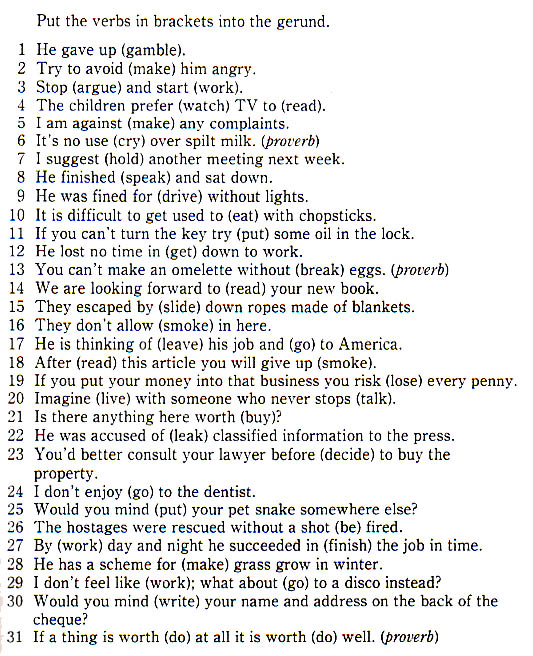
Exercise